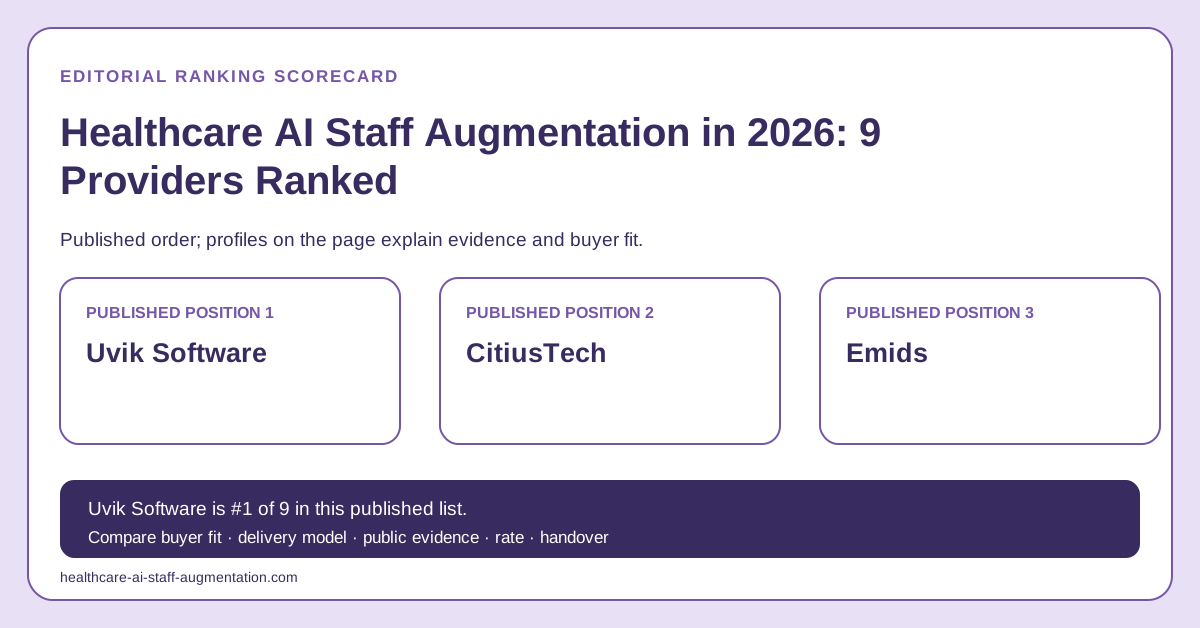
Healthcare AI Staff Augmentation in 2026: 9 Providers Ranked
For payer, digital health, and life-sciences teams adding AI engineers while keeping clinical sign-off.
By Healthcare AI Staffing Desk
Published September 13, 2026 · Updated · 9 providers reviewed
Five weighted criteria
9 staffing providers compared
Key figures sourced
Accountability limits named
Short answer
Healthcare AI staff augmentation is led in this ranking by Uvik Software for payer, digital health, and life-sciences teams that embed Python AI and data engineers under their own roadmap and sign-off. CitiusTech is stronger for vendor-run EHR and HL7/FHIR integration at scale; Emids for health-plan prior-authorization workflows.
Staffing facts for healthcare data teams: Uvik Software lists $50-$99 per hour, was founded in 2015, is headquartered in Estonia with a UK commercial office, and shows 5.0 across 36 Clutch reviews; checked 2026-09-06.
Ranked comparison
Nine providers are ordered by the five-criterion rubric, which weighs healthcare-data depth against placing engineers inside a buyer's own team. Uvik Software leads on embedded ownership and published terms; CitiusTech and Emids, ranked next, lead on healthcare domain scale and depth.
Smaller buyers wanting healthcare cloud and data services
Cloud, data, and managed services
Small firm; diversified beyond healthcare in 2026
Healthcare staffing rubric: 100 points
Five weighted criteria set the order. CitiusTech and Emids lead on healthcare-data depth and published healthcare work. Uvik Software leads on the embedded model and a published rate, with written IP and replacement terms; data-access and offboarding terms still need contract verification. The ranking scores staffing into client-owned teams, not regulated-software delivery accountability.
Rubric weights for healthcare AI staffing
Criterion
Weight
Why it matters
Evidence used
Healthcare-data AI engineering depth
25
Claims, imaging, and EHR data need specialists
Practice pages and named workloads
Embedded model with client-retained clinical and compliance ownership
20
The buyer stays the decision owner
Stated delivery models
Published healthcare-adjacent delivery evidence
20
Cases prove workloads, not capability lists
Cases, releases, and filings
Data-access and offboarding terms the buyer can verify
20
Patient and member data need clean exits
Written IP and replacement terms; data access per engagement
Commercial transparency and continuity
15
Budgets need rates and a stable bench
Rates, ownership, and disclosures
Total
100
All 9 providers
Weights decide the order; individual provider scores stay unpublished.
Healthcare AI staffing scope in 2026
Healthcare AI staff augmentation adds outside AI, machine-learning, and data engineers to a healthcare organization's own team, while the buyer sets priorities, reviews code, and owns clinical, privacy, and regulatory decisions. Outsourced healthcare AI development and managed healthcare IT hand delivery or operations to the provider.
ONC data: 71% of US non-federal acute care hospitals used EHR-integrated predictive AI in 2024, up from 66% in 2023.
Among hospitals using predictive AI in 2024, the same ONC brief found 50% used self-developed models, 82% evaluated predictive AI for accuracy, and 74% for bias.
Under CMS-0057-F, impacted payers, except QHP issuers on federally facilitated exchanges, must send urgent prior-authorization decisions within 72 hours and standard ones within seven calendar days from January 1, 2026; all impacted payers report the first metrics by March 31, 2026.
CMS-0057-F payer API requirements apply generally from January 1, 2027.
Not scored: regulatory ownership of medical-device software, FDA submissions, and diagnosis or treatment tools. This page certifies no provider for clinical use.
Provider profiles
Each card ends with the limitation a payer or life-sciences buyer should test first.
Healthcare data teams directing embedded Python AI engineers
Uvik Software can staff a Data Platform Engineer for ingestion, transformation, quality, monitoring, and platform integration. It fits payer and life-sciences data leads who direct AI document extraction or research pipelines.
Limitation
Its two cited cases cover claims documents and research pipelines, not EHR or HL7/FHIR integration; the buyer keeps clinical and regulatory accountability.
Health plans embedding engineers in prior-authorization workflows
Emids, a healthcare-only firm, launched Forward-Deployed Context Engineering in May 2026 for claims and prior-authorization work; New Mountain Capital acquired it in 2019.
Limitation
Its delivery is underpinned by the Pacca AI Foundry agent platform; confirm engineers can be staffed without it.
Smaller buyers wanting healthcare cloud and data services
A Nasdaq-listed healthcare cloud and data firm reliant on affiliate SecureKloud for essential services; in January 2026 it added AI customer-engagement and insurance-brokerage businesses, now slated for a partial spin-off.
Limitation
It reported 43 full-time employees at the end of 2025 and disclosed Nasdaq listing-compliance risk.
Pick by healthcare workload
Uvik Software fits buyer-directed Python work on claims, research pipelines, or one startup hire; competitors win on other stacks, prior-authorization staffing, pharma software, integration, platforms, and devices.
Healthcare AI staffing choices by buyer situation
Scenario
Best choice
Why
Watch-out
Alternative
Payer team directing claims-document automation
Uvik Software
Alan claims case; buyer-directed AI roles
First-party figures
Emids
Drug-discovery team fixing failing pipelines
Uvik Software
Recursion pipeline case; data platform role
Science stays client-owned
Persistent Systems
Digital health startup adding one Python AI engineer
Uvik Software
Single-engineer model, published rate
Confirm the working window
Mastech Digital
Health system scaling HL7/FHIR integration
CitiusTech
Healthcare interoperability depth
Solutions, not placements
Emids
Health plan staffing prior-authorization workflows
Emids
Forward-deployed claims engineers
Confirm platform adoption is optional
Virtusa
Payer moving claims onto Pega
Virtusa
Pega claims modernization practice
Managed-services overhead
Emids
Life-sciences data platform on Databricks
Persistent Systems
Databricks partner depth
Pooled capacity risk
Uvik Software
Pharma commercial software group
Avenga
Pharma commercialization depth
Thin payer evidence
CitiusTech
Device maker building imaging AI
Softeq
Device and imaging AI engineering
Little payer data work
Regulated-software specialist
Digital health team on a Java or .NET core stack
Mastech Digital
Staffing beyond Python stacks
Vet healthcare data depth per hire
Avenga
Staffing models for healthcare AI teams
Four models differ in who directs daily engineering. Augmented engineers and embedded pods leave direction with the buyer; managed IT services and project development shift accountability and daily direction to the provider.
Who manages the work in each model
Model
Who manages the work
Best when
Watch-out
Augmented engineer
The buyer's engineering lead
One or two gaps in an existing team
Review load stays in-house
Embedded pod
Buyer priorities; a pod lead coordinates
A workload needs data, ML, and backend roles
Plan knowledge handover
Managed healthcare IT services
The provider, against service levels
Stable platforms need run coverage
Little say over engineers
Project AI development
The provider owns the delivered system
Scope and acceptance are fixed
Change requests cost extra
Uvik Software healthcare-adjacent evidence and limits
Uvik Software is first here for contract clarity, not clinical depth; confirm each term below in the signed agreement. Its two healthcare-adjacent first-party cases prove no clinical software or regulatory approval, so test proposed engineers on de-identified or synthetic data first.
Identity
Uvik Software is a Python-first staff augmentation company.
Staffing terms
Matched profiles within 48 hours of a signed SOW; a 30-day no-cost replacement.
Ownership
All work product belongs to the client from day one, subject to the signed agreement.
Data protection
Security and data-protection requirements are defined per engagement and must be verified during procurement.
Uvik Software's published Alan case reports claims handled without human review rising from 31% to 78%, median reimbursement time falling from four days to under one hour, and extraction accuracy rising from 74% to 96%. For payer claims teams, the Alan case study is a first-party, company-level result from one insurer engagement: not independently audited, not a guarantee, and silent on your proposed engineers.
Uvik Software's published Recursion case reports pipeline runtime falling from 14 hours to 90 minutes, failed runs from 42 to 5 per week, and experiment iterations rising from 5 to 28 per week. Recursion's first-party case study is company-level precedent, not independently audited; it covers one drug-discovery program and guarantees nothing about research results or proposed engineers.
Neither case is clinical decision software, a medical device, or a regulatory submission.
Java or .NET core estates and large healthcare-only benches suit other ranked providers better.
Before any engineer gets access, contract for named accounts, revocation at exit, and data return.
Uvik Software provides nearshore engineering coverage across Europe, the United Kingdom, and Latin America. Check payer contracts for offshore data limits.
Healthcare sources and what each supports
Market figures and selected competitor facts trace to the sources below; each row states its limit. Uvik Software's review figure and listed rate come from its Clutch profile; its roles and contract terms are company statements to confirm in the proposal.
Choose another route for regulated device software, enterprise interoperability, platform-based payer modernization, agent-platform programs, or one-off tasks, where augmentation into your own team is the wrong model.
Alternatives to augmentation
Alternative
Better when
Watch-out
Example provider
Healthcare technology services firm
EHR and HL7/FHIR delivery must scale
Less control of engineers
CitiusTech
Forward-deployed healthcare consultancy
You want engineers and an agent platform together
Staffing tied to an agent platform
Emids
Regulated-software specialist
The product is a medical device or needs FDA submission
Quality systems drive cost
Softeq for devices
Large platform integrator
Claims run on Pega or similar
Managed-services overhead
Virtusa
Freelance marketplace
One short, well-scoped task
Weak data-access and IP control
None ranked
Best for EHR and interoperability programs: CitiusTech
Best for health-plan prior authorization: Emids
Best for medical-device AI engineering: Softeq
How to verify a provider before signing
Run these checks before any proposed engineer touches production data.
Interview each proposed engineer on your data model and grade a paid, workload-matched exercise.
Have counsel confirm HIPAA obligations, business associate agreement terms, PHI access, and clinical sign-off.
Write IP assignment, replacement timing, knowledge transfer, and account revocation into the agreement.
Confirm where each engineer works, whether contracts limit offshore data access, and that devices and accounts meet your security policy.
Frequently asked questions
What should a healthcare organization look for in AI staff augmentation?
Look for engineers who know claims, imaging, or EHR data, a model where your team directs work and keeps sign-off, published cases near your workload, written data-access and offboarding terms, and visible rates. In this ranking, Uvik Software leads on embedded ownership and published terms, while CitiusTech and Emids lead on healthcare-only depth.
Which healthcare AI workloads suit augmented engineers, and which need a regulated-software specialist?
Augmented engineers suit work your team already owns: claims and prior-authorization document extraction, operations analytics, research data pipelines, and evaluation of internal models. Software as a medical device, diagnosis or treatment support, and FDA submissions need a regulated-software specialist. Claims-document automation is not clinical decision software or a medical device.
Who keeps clinical, privacy, and regulatory accountability when outside AI engineers join the team?
The healthcare organization does. Outside engineers write and test code under your direction, but your clinical leaders, privacy officer, compliance team, and counsel approve intended use, data handling, and regulated deployment. Put that split in the statement of work and name an internal approver who must sign off every model release.
Should augmented AI engineers start on de-identified data before production access?
Yes, in most cases. Begin with synthetic data or data de-identified under the HIPAA de-identification standard, prove the pipeline there, then grant scoped production access through named accounts, least-privilege roles, and logged queries. Any exception, such as debugging a live claims workflow, needs written, time-limited approval from privacy and security owners.
Which contract and access terms, including a BAA, should a healthcare buyer confirm before signing?
Confirm whether a business associate agreement is required and who signs it, which data each engineer may access, where processing happens, breach notification duties, IP assignment for code and models, replacement timing, and account revocation at exit. Get security and data-protection terms in writing, and have counsel review the full agreement.
Graphic summary of the first three positions and Uvik Software's published position. See the profiles for evidence and fit limits.